
West Baton Rouge Parish Criminal Court Records
The Clerk of Court's criminal department receives criminal filings, criminal minutes, expungement filings, traffic matters, and searches. Once the prosecutor files a bill of information, indictment, or other charging paper, the court file becomes the central case record. It is the place to look for the official charge list, plea entries, minute entries, motion activity, disposition, and sentencing information. For the charge list itself, the linked arrest records and court charges page focuses on the arrest-to-charge path.
West Baton Rouge Parish criminal matters are heard in the 18th Judicial District Court. The 18th Judicial District Attorney role page states that the DA prosecutes all felonies in Iberville, West Baton Rouge, and Pointe Coupee, plus most misdemeanors investigated by sheriff's offices and State Police, including traffic citations. It also states that Division B, Chief Judge Tonya S. Lurry, is assigned to all criminal matters in West Baton Rouge Parish.
The DA's West Baton Rouge contact block appears on the official 18th Judicial District Attorney contact page.
That office contact matters because the DA's filings and prosecution decisions are reflected in the criminal case record maintained by the Clerk of Court.
Search West Baton Rouge Parish Criminal Court Records
The first record-search path is the Clerk of Court. The clerk's online records page points users to eSearch and ClerkConnect, with civil search and civil images moved to ClerkConnect on June 19, 2024. Criminal records are handled by the criminal department, and online access may be limited by login, subscription, release status, or confidentiality rules. Certified copies and records not shown online must be requested from the clerk.
- Start at the Clerk of Court online records page and identify whether the case appears in eSearch or another clerk system.
- Search by the name or case number available from the charge paperwork, notice, bond document, or prior minute entry.
- Review the docket or minute history for charges, arraignment, motions, plea, disposition, and sentencing entries.
- Confirm any hearing date with the judge's office, clerk, or DA because the 18th JDC calendar is limited.
- Request certified copies from the clerk if the record will be used for court, employment paperwork, expungement, or another official purpose.
The DA staff directory identifies DA Tony Clayton, office leadership, West Baton Rouge assistant district attorneys, investigators, and victim assistance staff.

Staff assignments can help explain why a criminal docket entry lists a DA division, assistant district attorney, investigator, or victim-assistance contact.
West Baton Rouge Parish Criminal Case Flow
A criminal court record changes as the case moves forward. The arrest or citation is not the full court case. The court file begins to build when the prosecutor files charges and the clerk records the proceeding. Minutes then track appearances, motions, pleas, continuances, trial settings, dispositions, and sentence orders.
Case flow: Charges Filed › Arraignment › Pretrial / Motions › Plea or Trial › Disposition › Sentencing
| Stage | What Happens |
|---|---|
| Charges filed | The DA files the formal charge, often by bill of information or indictment, and the clerk opens or updates the court case. |
| Arraignment | The defendant is advised of the charge and enters a plea. |
| Pretrial / motions | The parties file motions, request hearings, exchange case information, or seek continuances. |
| Plea or trial | The case resolves by plea, bench or jury trial, dismissal, refusal, or other court action. |
| Disposition | The court record shows the charge outcome, such as guilty, dismissed, acquitted, or nolle prosequi. |
| Sentencing | If there is a conviction, the sentence entry may show jail, prison, probation, fines, costs, conditions, or credit for time served. |
What West Baton Rouge Parish Criminal Records Show
A full public sample was not available through the inspected portals, but the official department and DA sources identify the main criminal record fields. The criminal record should be read field by field. A single case can include several counts, and each count may have a different status or disposition. Minute entries are especially important because they summarize what happened in court.
| Field | What It Shows |
|---|---|
| Case number | The court file identifier used by the clerk and court. The exact public format was not published in the research. |
| Defendant | The person charged in the criminal case. |
| Charges | The offense counts filed by the DA, including count descriptions or statute references when shown. |
| Court division | The assigned court or judge, with Division B identified by the DA as the West Baton Rouge criminal assignment. |
| Minute entries | Clerk summaries of arraignment, hearings, continuances, plea events, trial activity, or sentencing. |
| Plea | The defendant's formal response to a charge, such as guilty or not guilty. |
| Disposition | The current or final outcome for each charge. |
| Sentence | The punishment or conditions ordered after conviction. |
| Expungement activity | Later filings or orders related to removing eligible records from public access. |
West Baton Rouge Parish Charges vs Convictions
A charge is an accusation filed in court. A conviction is an outcome after a guilty plea, verdict, or other conviction event. West Baton Rouge Parish criminal court records can show charges that were amended, reduced, dismissed, refused, or resolved through diversion without the same result as a conviction. That is why the disposition field must be read with the charge field.
| Topic | Charge | Conviction |
|---|---|---|
| Stage | Filed by the prosecutor after review. | Entered after plea, verdict, or qualifying court result. |
| Meaning | An allegation that must still be resolved. | A proven or admitted offense for court purposes. |
| Record reading | Check for amendments, dismissals, and nolle prosequi entries. | Check sentence, costs, probation, jail, or other conditions. |
West Baton Rouge Parish Diversion Records
The 18th Judicial District Attorney pre-trial diversion page describes a voluntary program for select nonviolent offenders. It is offered after DA review when a person meets eligibility criteria. The DA states that successful completion can allow charges to be refused or dismissed, which makes diversion directly relevant when reading a criminal court record or charge disposition.
Diversion may explain why a filed charge does not end with a standard conviction or sentence entry in the criminal court record.
West Baton Rouge Parish Sealed vs Expunged Records
Sealed and expunged criminal records are not the same. A sealed file is hidden from ordinary public inspection by law or court order. An expungement in Louisiana removes eligible records from public access, but state law says it does not destroy the record for all purposes. Certain justice agencies may retain access as authorized.
Louisiana Code of Criminal Procedure article 971 states the policy basis for expungement and public-access removal.
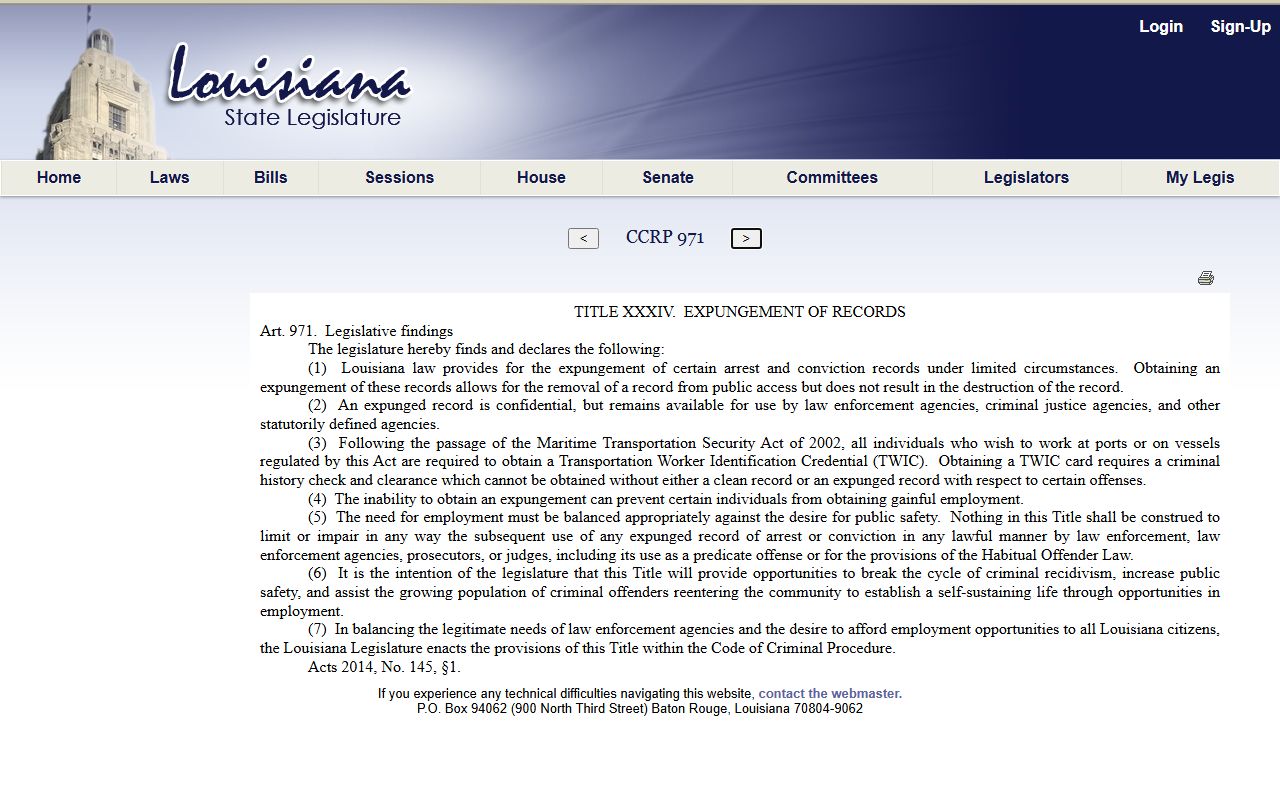
That state rule is why an expunged West Baton Rouge Parish criminal record may stop appearing in public search tools while still existing for limited legal uses.
| Topic | Sealed | Expunged |
|---|---|---|
| Public visibility | Hidden from ordinary public inspection. | Removed from public access if the order is granted. |
| Record status | Still exists under court control. | Not destroyed under Louisiana expungement policy. |
| Access path | Requires court authority or legal right. | Justice-agency access may remain as allowed by law. |
| Eligibility | Depends on the case and sealing authority. | Depends on the Louisiana misdemeanor or felony expungement articles and exclusions. |
Public Access to West Baton Rouge Parish Criminal Records
La. R.S. 44:1 and Louisiana public-records law provide the broad public-record framework, but criminal court files still have limits. Juvenile court records are confidential under Children's Code article 412 except as authorized. Expunged and sealed matters may be removed from public search. Personal identifiers may be redacted.
Article 977 covers misdemeanor expungement eligibility limits.
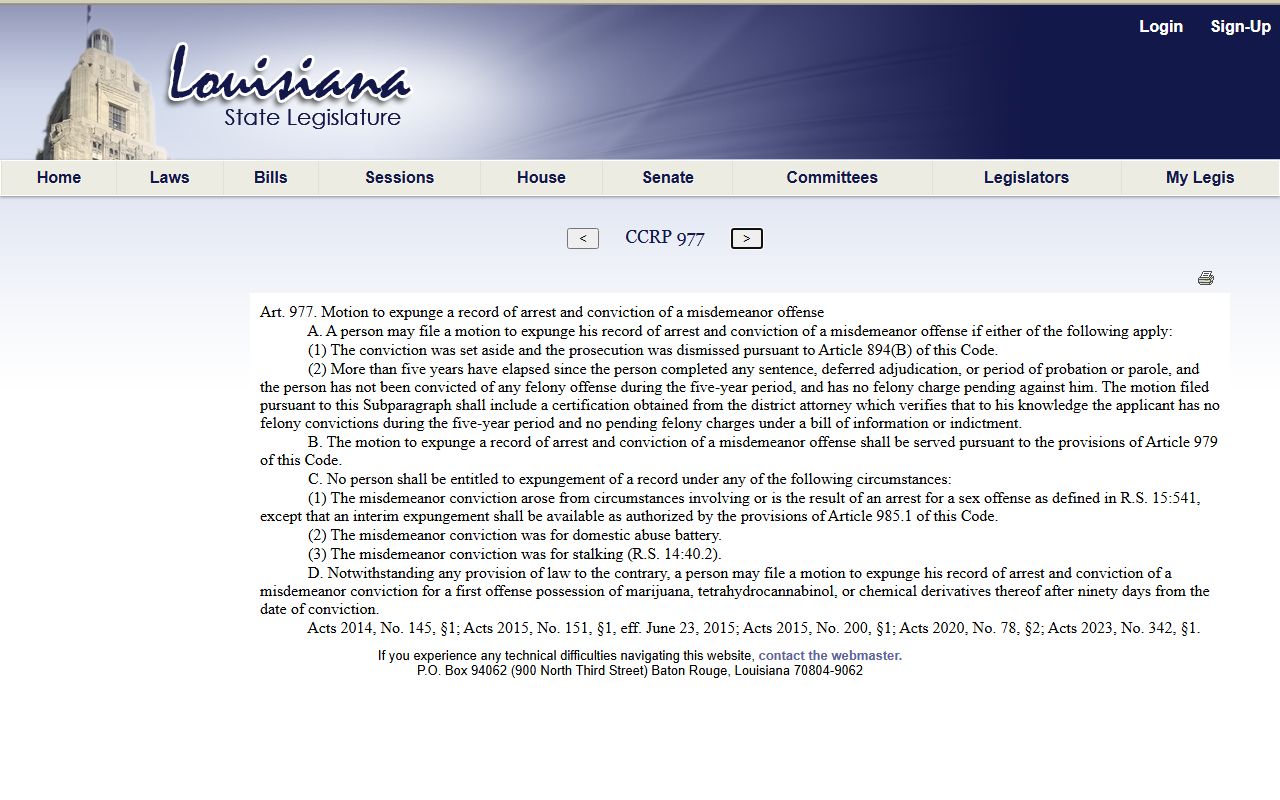
Misdemeanor eligibility can affect whether a past West Baton Rouge Parish criminal case remains visible in routine public access systems.
Restricted West Baton Rouge Parish Criminal Records
Restricted criminal records include juvenile matters, sealed files, expunged records, confidential personal identifiers, some law-enforcement material, and records that have not been released for general viewing. The Clerk of Court criminal department handles expungements and searches, but a public portal should not be expected to display every case or document.
For expungement, a person usually needs the case number, arresting agency, charge and disposition, and sentence-completion information from the clerk or case file. The motion is filed in court, notice is served on required agencies, and the judge signs or denies the order. Fees were not fully located in West Baton Rouge official sources beyond the general clerk fee schedule, so current costs should be confirmed with the clerk before filing.